Tampilkan postingan dengan label architecture. Tampilkan semua postingan
Minggu, 03 Januari 2016
archaeology
,
architecture
,
beaches
,
cathedrals
,
holidays
,
monuments
,
musuem
,
nature
,
photography; exhibits
,
snowboard
Tidak ada komentar
TOURING AROUND TORREVIEJA


My travel writer friend Inka invited me to visit her in Spain last September. She lives in Torrvieja, a lovely seaside city on the Costa Blanca. The name of the town comes from the original ancient guard tower (Torre Vieja meaning Old Tower) which once guarded the harbour. Torrevieja was originally a salt-mining and fishing village, located between two large salt lakes, one blue/green, the other pink, caused by the pigments and algae of the salty environment. The lakes are now an official nature reserve attracting a wide variety of bird life. The main attraction are the flamingos. Up to 2000 can be seen there during breeding season. Did you know that the flamingos turn bright pink from eating the shrimp from the salty water? The salt lake at La Mata lagoon produces pyramids of salt most of which is exported abroad.
During the 19th century, salt was shipped from Torrevieja. Salt and fishing are the major industries.
Today Torrevieja is a popular resort for holidayers from England, France, Germany and Russia. A lot of Brits have retirement homes here.
Inka and I had fun exploring the sights. On my first day there we met up with our friend Darlene Foster, a Vancouver travel writer who lives nearby. We spent an excellent day touring the pirate's island of Tabarca, a short boat trip from Torrevieja. (see my previous blog).
The city itself has various interesting historical sites which we explored including the two main churches - the Hermitage (new) and the Virgin of Cenception (old).
The next day we got the bus to CARTEGENA, an old historical city famous from the Punic Wars. This is where Hannibal set off with is elephants on his journey to Rome.
Cartagena has been inhabited for over two millennia, founded in 227 BC by the Carthaginians. During the Roman Empire it was known as Carthago Nova (the New Carthage) and was one of the most important cities of the time because of its defensive port, one of the most important sea ports in the western Mediterranean. The city is now a major destination for cruise ships.


Remains of the Punic Walls


Roman Theatre

Roman Villa

There are many things to see in Cartegena including 12 museums, several noteworthy churches and monuments as well as the archaeological sites. We walked along the Calle Mayor and admired the many beautiful art deco houses then relaxed at a cafe bar.


A Delicious Lunch
The following day we took a bus to a small city nearby, Santa Palo. We walked through the town to see the old church and the 16th century castle. Unfortunately all the museums were closed. I'd have liked to see the Salt Museum but I did see the salt lakes and piles of salt heaped nearby.

16th century Castle


Seaside View
Our pleasant outing concluded with a nice lunch in a good restaurant (chorizo flambe in rum and potatoes with ali olli - garlic sauce).
It was a pleasant visit with my friend and I appreciated seeing all the sights of these interesting old cities.
The next day I took the bus to Murcia and from there, another relaxing bus journey to Malaga where I'll stay a few days visiting my friends Carlos and Natalia.
Selasa, 24 November 2015
TREDEGAR HOUSE: Home of one of Wales Most Illustrious Families

TREDEGAR HOUSE
Tredegar House, near Newport Wales, was the home of the Morgan family for over 500 years and later the home of the Lords Tredegar, one of the most powerful and influential families in the area. The mansion is surrounded by a landscaped garden of 90 acres and is one of the most outstanding houses of the Restoration period in Britain. The earliest part of the building dates back to the late 15th century but it�s been restored over the ages. It was originally built of stone and later rebuilt with red brick.


The name Tredegar came from Tredegar Fawr, the name of the mansion of the old Morgans who were descended from Cadifor the Great, the son of Collwyn who owned the land where the mansion stands. It was occupied by the Morgan family from about 1402. The earliest documented owner was Llewelyn ap Morgan. The Morgans were one of the most powerful and influential families in the area. In 1448 John Morgan was created a Knight of the Holy Sepulchre and was rewarded for his support of King Henry VII. Around 1490 he commissioned the building of a new house at Tredegar, though a wing of the original stone manor house still exists. The newer palatial house was visited by Charles I and his retinue during the 1600�s.
We walked through the gardens and passed through the high ornate Edney Gates to get into the building. The gilded gates were built between 1714 and 1718 for John Morgan and are an example of early 18th century decorative wrought ironwork. Just past the gates is the Stable Block which housed the many horses owned by the family.


The Edney Gates
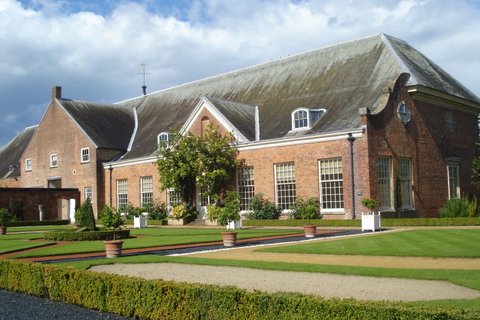

Once inside the palatial mansion, the docent showed us the way to proceed through the various rooms, all furnished in the style of the period with oil paintings on the walls. In one of the rooms there was a large oil painting of Godfrey Morgan who fought in the Charge of the Light Brigade. He is pictured with his famous steed, Sir Briggs. Morgan, age 22 and Captain in the 17th Lancers, and his horse survived the battle. They lived at Tredgar house until the horse�s death at the age of 28. Sir Briggs was buried with full military honours in the Cedar Garden of Tredgar House. There were luxurious bedrooms with decorative furnishings, everything laid out as if the rooms were still occupied by the ladies and gentlemen of the family. In the dining room there was even food displayed on the tables to illustrate the sumptuous feasts that were served there.
Every room we visited had display of the history of this illustrious family, throughout the generations.


Godfrey Morgan and Sir Briggs


The Dining Room
The Morgans were a renown family. Besides the infamous Caribbean privateer, Henry (Sir Harri) Morgan who began as an admiral of the Royal Navy, there are many tales of ill-fated marriages, riotous parties, war heroism and even the dark arts. The docent hosts at the house related some of these tales to us as we walked through the various room.


We visited the servant's quarters and kitchens which were reminiscent of the popular TV series Downton Abbey. There some of the secrets of the servants were revealed including concealed drawers full of spices and a silver safe that was always protected by a guard.


Buzzers for calling servants

Kitchen

Head Servant's quarters
Eventually the family's financial assets were depleted through their extravagant lifestyle and the eccentricities of the owners. The last Baron of Tredegar, John Morgan, died childless in 1962 at aged 54. His death was the end of the Morgans of Tredegar. In 1951 the house was stripped and the contest auctioned. It was turned over the National Trust and refurbished in 2012.
Sabtu, 13 Juni 2015
architecture
,
baroque
,
castles
,
churches
,
Germany
,
history.
,
Rhine River
,
sight-seeing
Tidak ada komentar
CASTLES ON THE RHINE AND A VISIT TO A MEDIEVAL TOWN
On my return home from Greece last October, I stopped for a few days in Mainz, Germany to visit my friend Patrick. I told him I'd like to see some of the Rhine Castles and he had arranged with his friends Wolfgang and Jurgen to drive us to several sites. We hopped on the train at Mainz and rode to a town nearby where Patrick's friends were waiting. 








Above the church stands the ruins of the Chapel of St. Werner dating from the early 14th century and above that, stands Stahlick Castle, a fortified castle dating to the 12th century.


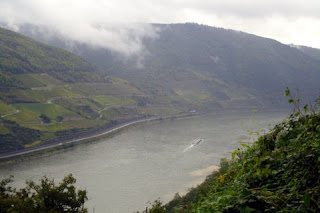
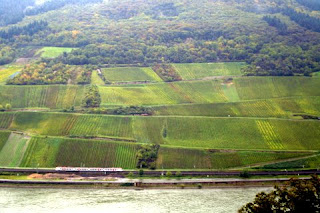
It happened to be a rainy day, but that wasn't going to stop us from having lots of fun. We drove along the scenic river enjoying the views of vineyards that grow up the steep banks and river boats plying they way upriver.Even in the rain the scenery was beautiful.


Patrick, Jurgen and Wolfgang, my tour guides.


Rhine vineyards
Our first stop was the Sooneck Castle, built on the ruins of a Medieval castle by Prussian princes as a neo-Gothic hunting lodge. The castle was constructed in 1282, destroyed in the Palatinate War of Succession in 1689, and acquired by Frederick William, Crown Prince of Prussia and his brothers in 1834.


Sooneck Castle
An amusing little Russian guide named Leo greeted us as we entered and showed us through the various castle rooms. He explained all the artifacts on display from the long-bow hunting equipment to the bedrooms, which weren't actually slept in but more for show.

Our Castle guide, Leo

bedroom


dining room

crossbow for hunting
It was still raining when we left the castle but the weather began to clear by the time we reached the picturesque little Medieval town of Bacharach located where the Steeg Valley meets the Rhine Valley at a juncture near the old Roman road, Aosonius Way, which connected Mainz with Trier, branching off from the Roman riverbank road. The area was first recorded settled in 1094 bu probably was inhabited from antiquity.

old gate entrance


craftsman and his art

In the Middle Ages the town of Bacharach was an important outpost on the Middle Rhine, an economically prominent site as a place of transfer, trade and warehousing for wine and timber. We entered through a gateway in the original stone wall of the city. It was like stepping into a picture book, with quaint timbered houses and narrow streets, obviously these days a popular tourist site.


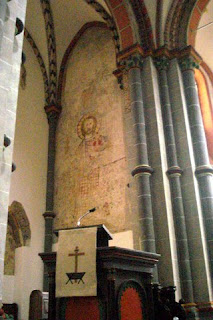
The Church of St. Peter


Interior of Church of St Peter


Located in the centre of Bacharach, the Church of St. Peter is dated between 1230/40 but has gone through numerous changes and renos. It has a baroque style sacristy and is one of the most unique examples of Romanesque architecture on the Lower Rhine. The Church is surrounded by courtyards and open-timbered houses, many from the late Middle Ages. The town's post office tower dates from the early 1400s.


Above the church stands the ruins of the Chapel of St. Werner dating from the early 14th century and above that, stands Stahlick Castle, a fortified castle dating to the 12th century.

Before heading off to explore Stalick Castle we stopped in a quaint restaurant for a typical German meal of veal schnitzel and beer.


On our way to Stahlick Castle

Stalick Castle, towers over Bacharach
Today Stahlick Castle is used as a youth hostel. There were children frolicking in the courtyard wearing capes and sparring with pretend swords.
http://www.jugendherberge.de/en/youth-hostels/bacharach390/shortportraet


On our trip back we stopped at the ruins of another castle overlooking the river, where there is now a first-class hotel and restaurant built in its place.

View of the Rhine River

Remains of old castle


The views along the river were magnificent even through the mist. In spite of the weather, we had an excellent day exploring and enjoying the sites along the majestic Rhine.
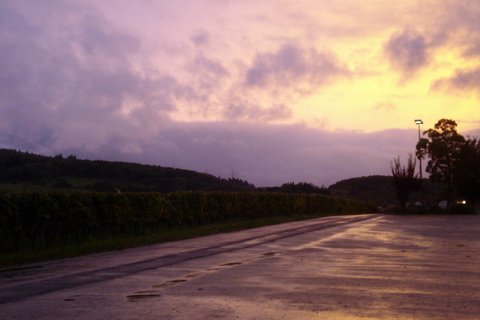
Sunset

Town View

Langganan:
Postingan
(
Atom
)