Tampilkan postingan dengan label Plaka. Tampilkan semua postingan
Jumat, 13 Maret 2015
WANDERING AROUND PLAKA.
When I first visited Athens back in 1979, it was the Plaka that attracted me most. I stayed in an old walk-hotel on Aeolou St. and wandered the area (though for some odd reason, those first few visits I totally missed Plaka Square, choosing instead to hang out in the area around Hadrian's Library and the old Roman Agora. Perhaps because I had made friends with the taverna workers there and they always made me feel at home.

This appealed to me partly because "Vironos Street" was "Byron's Street" named so because at one time there was a small monastery at the end of the street where he used to stay. And right around the corner from that was Shelley Street named after Percy Byce Shelley, Bryon's poet friend.
My suite opened to a lovely courtyard in which there was another small house (spitaki) and over the years a variety of interesting people lived there including artists and writers. Most of my years at #14 though it was Roberto, an artist from Argentina, who became my best friend. The owners lived upstairs, Dina and Ioannis and yiayia - lovely people, so friendly and accommodating. And in another small house behind Robert's spitaki, in a back courtyard, was a workshop of one of the curator's of the acropolis museum (the old museum) where he was often restoring old statues.
Down the street at the place where Bryon used to live, there was a milk shop. The excavation on the old monastery site had caused a lot of dust so we called it "The Dirty Corner". Right there at the corner was the old monument of Lysikratis, a tripod monument award the chorus of a drama held long ago in the ancient theatre of Dionysus. This are, it seems, was once the theatrical part of old Athens. That suited me fine!

I still love browsing around Plaka every time I'm in Athens. It's quite touristy with many souvenir shops, tavernas and tables crowded with visitors, but it's a fun part of town. I used to pass #14 every day I was there and look through the gate. Sadly the owners are no longer there and the last time I went the gateway was totally boarded up. The Dirty Corner is now a rather posh restaurant. And the dust is gone from the excavations.
One of the things about Plaka is all the graffiti. This is a big thing in Athens - good or bad. I find it upsetting in some cases but in others it is attractive and artistic. Sometimes it's political slogans or people's names sprayed on the old walls, but often it is well-crafted artwork. What I don't like is when it's sprayed on neo-classical buildings.


There's lots to see around Plaka from the shops to the old ruins and Plaka Square is a great place to meet up and enjoy a cold frappe or a beer at one of the sidewalk tables, or to just sit inside the square on a bench under the trees to watch passers-by.

Plaka is the old Athens and that's what I like most about it -- philosophers and dramatists once walked those cobbled streets. And yes, people like Byron and Shelley too! And once when I was sitting in Square who came strolling by escorted by her 'bodyguards', dressed all in white, her red-gold hair like a halo, but the beautiful Greek actress Melina Mercouri. There's a museum for her now in one of the old houses.


From Plaka you can visit the Monastiraki bazaar and experience some of the Ottoman parts of the city alongside the Roman. And towering above it all is the magnificent Acropolis crowned with the Parthenon. If you want some quiet away from the bustle of it all walk along the pedestrian roadway beside the Herod Atticus Theatre and you'll come to the tree-covered Filopappou Hill and a bit farther than that, pathways through the trees will lead you to the Hill of Nymphs, my favorite picnic spot.
And whatever you do, don't miss the New Acropolis Museum which is one of the most wonderful museums I've ever visited. I had the thrill of watching it being built from the first excavations to the shining finished product. It's all part of my old 'hood!
PLAKA
I decided to go to live in Athens in 1983 but a friend and I had an apartment farther away in the Koukaki district. It wasn't until 1984 that I moved into Plaka in a basement suite at #14 Vironos St.This appealed to me partly because "Vironos Street" was "Byron's Street" named so because at one time there was a small monastery at the end of the street where he used to stay. And right around the corner from that was Shelley Street named after Percy Byce Shelley, Bryon's poet friend.
My suite opened to a lovely courtyard in which there was another small house (spitaki) and over the years a variety of interesting people lived there including artists and writers. Most of my years at #14 though it was Roberto, an artist from Argentina, who became my best friend. The owners lived upstairs, Dina and Ioannis and yiayia - lovely people, so friendly and accommodating. And in another small house behind Robert's spitaki, in a back courtyard, was a workshop of one of the curator's of the acropolis museum (the old museum) where he was often restoring old statues.
Down the street at the place where Bryon used to live, there was a milk shop. The excavation on the old monastery site had caused a lot of dust so we called it "The Dirty Corner". Right there at the corner was the old monument of Lysikratis, a tripod monument award the chorus of a drama held long ago in the ancient theatre of Dionysus. This are, it seems, was once the theatrical part of old Athens. That suited me fine!
Milk shop (now a posh cafe) at the "Dirty Corner"
I still love browsing around Plaka every time I'm in Athens. It's quite touristy with many souvenir shops, tavernas and tables crowded with visitors, but it's a fun part of town. I used to pass #14 every day I was there and look through the gate. Sadly the owners are no longer there and the last time I went the gateway was totally boarded up. The Dirty Corner is now a rather posh restaurant. And the dust is gone from the excavations.
One of the things about Plaka is all the graffiti. This is a big thing in Athens - good or bad. I find it upsetting in some cases but in others it is attractive and artistic. Sometimes it's political slogans or people's names sprayed on the old walls, but often it is well-crafted artwork. What I don't like is when it's sprayed on neo-classical buildings.
There's lots to see around Plaka from the shops to the old ruins and Plaka Square is a great place to meet up and enjoy a cold frappe or a beer at one of the sidewalk tables, or to just sit inside the square on a bench under the trees to watch passers-by.
One of my favorite taverans on Tripidon Street
Plaka is the old Athens and that's what I like most about it -- philosophers and dramatists once walked those cobbled streets. And yes, people like Byron and Shelley too! And once when I was sitting in Square who came strolling by escorted by her 'bodyguards', dressed all in white, her red-gold hair like a halo, but the beautiful Greek actress Melina Mercouri. There's a museum for her now in one of the old houses.
Roman Agora
former Mosque, now folk art museum
Former Turkish school
Plaka Street
Plaka Wine Bar
From Plaka you can visit the Monastiraki bazaar and experience some of the Ottoman parts of the city alongside the Roman. And towering above it all is the magnificent Acropolis crowned with the Parthenon. If you want some quiet away from the bustle of it all walk along the pedestrian roadway beside the Herod Atticus Theatre and you'll come to the tree-covered Filopappou Hill and a bit farther than that, pathways through the trees will lead you to the Hill of Nymphs, my favorite picnic spot.
And whatever you do, don't miss the New Acropolis Museum which is one of the most wonderful museums I've ever visited. I had the thrill of watching it being built from the first excavations to the shining finished product. It's all part of my old 'hood!
Kamis, 29 Januari 2015
archaeology
,
folklore
,
historical sites
,
history. music
,
mosques
,
Ottoman
,
Plaka
,
Romans
Tidak ada komentar
THE BATH-HOUSE OF THE WINDS and Other Ottoman and Roman Places to Visit in Plaka
?

Plaka
There's a lot more than ancient Greek ruins around Athens. In the Plaka you'll find remains of the Romans and Ottoman Turks as well as the Classical. The Romans took control of the city in the second century BC and added some of their own architectural splendor, though it could never match the Greek's. During his reign from 117 - 138 AD the Emperor Hadrian left his mark in many areas. www.europeupclose.com/article/greece-hadrians-athens/ Beyond Hadrian's Arch which marked the border of Classical Athens, was the Roman city, including the Roman baths. Although it had been begun centuries earlier, he also put the finishing touches on the Temple of Olympian Zeus. Hadrian built a library in the Plaka area and nearby is the Roman Forum with it's notable Tower of the Winds. Years later, a wealthy Roman senator built the Herodes Atticus theatre in honour of his wife. Today the "Herodian" is a popular theatre for nusic concerts and staging ancient dramas. 
Roman Forum
The Tzistarakis mosque, built in 1759, dominates Monastiraki Square. It is now the Museum of Greek Folk Art: Ceramics Collection. Take time to go inside and see the collection of pottery and other artifacts


Tzistarakis Mosque
The oldest mosque in Athens, the Fethiye Tzami built in 1458 occupies a corner of the Roman Forum. It is now used to store artifacts found around the site.
Across from the Forum entrance are the remains of the medresse, an Islamic school. During the Ottoman rule and Greek independence it was used as a prison and notorious for it's harsh conditions. A tree inside the courtyard was used for hangings. The prison was closed in the early 1900's and most of it was torn down.

Turkish Medresse
A place that has always intrigued me, is the Turkish bath house. Finally this time in Athens I was lured inside and spent a pleasant hour wandering the halls and rooms. It was originally built in the 1450's and has been carefully restored. Roman and Byzantine bath-houses served as models for the Turkish hammams though there were some differences to meet the prescription of the Koran. The baths were used in shifts by men and women until an expansion in the 19th century provided more space for what you see today. Restoration work was completed in 1998. It's called "The Bath-house of the Winds" and is located at Kyrrestou 8, a street that leads to the back of the Roman Forum near the Tower of the Winds. It's open Mon & Wed- Sun 9 am- 2.30 pm. Free.
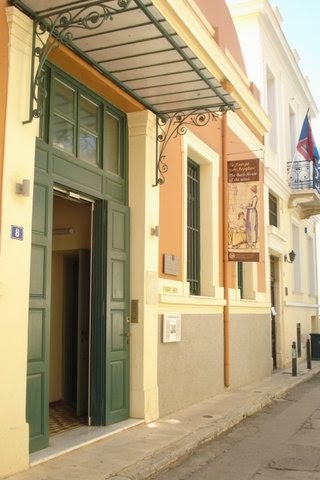

Bath-house of the Winds


Museum of Greek Folk Instruments
Langganan:
Postingan
(
Atom
)