Tampilkan postingan dengan label Ottoman. Tampilkan semua postingan
Kamis, 29 Januari 2015
archaeology
,
folklore
,
historical sites
,
history. music
,
mosques
,
Ottoman
,
Plaka
,
Romans
Tidak ada komentar
THE BATH-HOUSE OF THE WINDS and Other Ottoman and Roman Places to Visit in Plaka
?

Plaka
There's a lot more than ancient Greek ruins around Athens. In the Plaka you'll find remains of the Romans and Ottoman Turks as well as the Classical. The Romans took control of the city in the second century BC and added some of their own architectural splendor, though it could never match the Greek's. During his reign from 117 - 138 AD the Emperor Hadrian left his mark in many areas. www.europeupclose.com/article/greece-hadrians-athens/ Beyond Hadrian's Arch which marked the border of Classical Athens, was the Roman city, including the Roman baths. Although it had been begun centuries earlier, he also put the finishing touches on the Temple of Olympian Zeus. Hadrian built a library in the Plaka area and nearby is the Roman Forum with it's notable Tower of the Winds. Years later, a wealthy Roman senator built the Herodes Atticus theatre in honour of his wife. Today the "Herodian" is a popular theatre for nusic concerts and staging ancient dramas. 
Roman Forum
The Tzistarakis mosque, built in 1759, dominates Monastiraki Square. It is now the Museum of Greek Folk Art: Ceramics Collection. Take time to go inside and see the collection of pottery and other artifacts


Tzistarakis Mosque
The oldest mosque in Athens, the Fethiye Tzami built in 1458 occupies a corner of the Roman Forum. It is now used to store artifacts found around the site.
Across from the Forum entrance are the remains of the medresse, an Islamic school. During the Ottoman rule and Greek independence it was used as a prison and notorious for it's harsh conditions. A tree inside the courtyard was used for hangings. The prison was closed in the early 1900's and most of it was torn down.

Turkish Medresse
A place that has always intrigued me, is the Turkish bath house. Finally this time in Athens I was lured inside and spent a pleasant hour wandering the halls and rooms. It was originally built in the 1450's and has been carefully restored. Roman and Byzantine bath-houses served as models for the Turkish hammams though there were some differences to meet the prescription of the Koran. The baths were used in shifts by men and women until an expansion in the 19th century provided more space for what you see today. Restoration work was completed in 1998. It's called "The Bath-house of the Winds" and is located at Kyrrestou 8, a street that leads to the back of the Roman Forum near the Tower of the Winds. It's open Mon & Wed- Sun 9 am- 2.30 pm. Free.
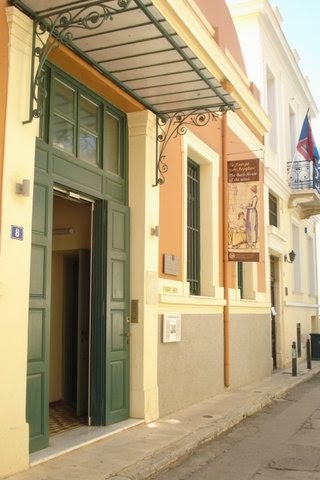

Bath-house of the Winds


Museum of Greek Folk Instruments
Senin, 01 Desember 2014
archaeology
,
architecture
,
Byzantine churches
,
mosques
,
Ottoman
,
travel
,
Turkey
Tidak ada komentar
THESSALONIKI: VISITING THIS CITY'S RICH HISTORY
I have visited Thessaloniki (in Greek Macedonia) several times beginning with 1979, my very first trip to Greece. I stopped there first specifically so I could go to the Archaeological Museum and see the amazing finds that were on display from the tombs at Vergina. I've visited there a few times since then, usually when I was on research trips for SHADOW OF THE LION. My stops were brief and each time I'd try to take in a bit of the city.

The Ottoman Turks invaded Greece in 1430. They called the city "Selanik". Thessalonki became one of their major cities. , The population of the city was composed of Slavs, Albanians, Armenians and the largest Jewish community in Europe. Greek Orthodox Christians were a minority.
In 1917 a fire leveled most of the city destroying the old buildings including the entire Jewish quarter. Later the city was rebuilt in an Art Deco style under the supervision of French architect and archaeologist Ernst Hebrard.

When I visit Thessaloniki I usually stay at a hotel on the main street, Egnatia, making it an easy walk to see all the sights. Just a few blocks from my hotel is the pleasant plateia of Aristoteles with it's palms and gardens and a statue of the famous philosopher a focal point. There are tavernas and shops on each side of the plateia. As I stopped at one for a refreshing drink, I saw a group of men at a table nearby who looked surprisingly just like I imaged the generals in SHADOW must have looked!


The old and new sections of the the city are marked by the Exhibition grounds and the seaside walk dominated by the famous White Tower (Lefkos Pyrgos), part of the Fortress of Kalamaria that once formed the corner of the city's Byzantine and Ottoman defences. The walls were demolished in the late 19th century. Before that it was known as the Bloody Tower, an infamous place of imprisonment and execution. It is said that a Jewish prisoner was offered his freedom if he painted the tower white. Hence the name "White Tower".

The sea walk is one of my favorite parts of Thessaloniki. I love the long stroll and after stopping for a delicious lunch of calamaria in pesto sauce, among the company of a bevy of handsome young folk, I set off for a walk, heading toward the White Tower and another of my favorite sites in the city: the statue of Alexander the Great astride his famous horse Bucephalus. The statue faces East, toward his conquests. It is surrounded by a wall with a frieze depicting his battle with the Persians, a row of tall sarissas, the spears used by the phalanx troops, and a stand of shields each with the inscription of the tribe or batallion of the soldiers. Near the statue is theVassilika Theatre where I noticed a large bill-board advertising a production of "Alexander: the Musical".


 Just around the corner is the Archaeological Museum and although the treasures from the tombs have been removed to their original site at Vergina, there are still many fascinating artifacts on display. At the museum cafe while I was enjoying a frappe, I spotted a young man who looked exactly like I imagine Alexander had looked. I tried to take a photo of him as he passed by but didn't get a good shots. That's only the third time in all my travels in Greece I have seen someone who resembled my historical hero.

I had intended to take a side trip to Pella, the Royal City where Alexander was born. However my time was limited so I decided instead to spend the next day exploring the parts of Thessaloniki that I had not seen before. Fortunately my hotel was not far from many of these historical buildings.
Just around the corner I found an Ottoman bazaar.


Now I was in Thessalonki's Upper Town, the old Turkish area. I passed through the gardens that surround a 15th century mosque.


Thessaloniki (Salonika) definitely has a different ambience than Athens. The city has a long history, founded in 315 BC by Kassandros (who happens to be the villain of my novel) after he coerced Alexander's half-sister Thessaloniki to marry him, thereby getting his foot in the door of the Macedonian royalty. The site was originally the ancient Greek settlement of Thermae. In 146 BC the Romans arrived and took over the city. Christiany had its beginnings in Thessalonki when the Apostle Paul visited. He founded a church there in 56 AD and wrote two Epistles to the Thessalians. The Emperor Galerius took control three centuries later. The first Christian Emperor was Theodosius (379-95) who ended paganism. When the Emperor Justinian ruled (527-65) Thessaloniki became the second most important city of Byzantium after Constantinopole.
The Ottoman Turks invaded Greece in 1430. They called the city "Selanik". Thessalonki became one of their major cities. , The population of the city was composed of Slavs, Albanians, Armenians and the largest Jewish community in Europe. Greek Orthodox Christians were a minority.
In 1917 a fire leveled most of the city destroying the old buildings including the entire Jewish quarter. Later the city was rebuilt in an Art Deco style under the supervision of French architect and archaeologist Ernst Hebrard.
When I visit Thessaloniki I usually stay at a hotel on the main street, Egnatia, making it an easy walk to see all the sights. Just a few blocks from my hotel is the pleasant plateia of Aristoteles with it's palms and gardens and a statue of the famous philosopher a focal point. There are tavernas and shops on each side of the plateia. As I stopped at one for a refreshing drink, I saw a group of men at a table nearby who looked surprisingly just like I imaged the generals in SHADOW must have looked!
Aristotle
?
The plateia opens to the sea walk with it's beautiful neo-classical buildings and many restaurants and tavernas populated by groups of young people. Thessalonki is a university city and there seems to be a large portion of the population are young folk, likely students. As a result Thessalonki has a lively music and theatre scene. The old and new sections of the the city are marked by the Exhibition grounds and the seaside walk dominated by the famous White Tower (Lefkos Pyrgos), part of the Fortress of Kalamaria that once formed the corner of the city's Byzantine and Ottoman defences. The walls were demolished in the late 19th century. Before that it was known as the Bloody Tower, an infamous place of imprisonment and execution. It is said that a Jewish prisoner was offered his freedom if he painted the tower white. Hence the name "White Tower".
The sea walk is one of my favorite parts of Thessaloniki. I love the long stroll and after stopping for a delicious lunch of calamaria in pesto sauce, among the company of a bevy of handsome young folk, I set off for a walk, heading toward the White Tower and another of my favorite sites in the city: the statue of Alexander the Great astride his famous horse Bucephalus. The statue faces East, toward his conquests. It is surrounded by a wall with a frieze depicting his battle with the Persians, a row of tall sarissas, the spears used by the phalanx troops, and a stand of shields each with the inscription of the tribe or batallion of the soldiers. Near the statue is theVassilika Theatre where I noticed a large bill-board advertising a production of "Alexander: the Musical".
Alexander the Great?
?
I had intended to take a side trip to Pella, the Royal City where Alexander was born. However my time was limited so I decided instead to spend the next day exploring the parts of Thessaloniki that I had not seen before. Fortunately my hotel was not far from many of these historical buildings.
Just around the corner I found an Ottoman bazaar.
?
Near the water front is an early 20th century house that once belonged to a Jewish family now a Jewish museum. During WW II all the Jews in Thessaloniki were rounded up and taken to internment camps. About 90,000 of them were killed. There was once a Jewish cemetary in Thessalonki but it was destroyed by the Nazis. ?
I wandered down Egnatia Street, past the Bey Hamam, Turkish Baths, and up through the park area of the Plateia Dieikastrion to the site of the old Roman Form. ?
Roman Ruins
Back on Egnatia St. I passed two old Byzantine churches. Many of these churches were converted to mosques during the Ottoman occupation and many others were damaged in the fire of 1917. I finally reached the famous Arch of Galerius and a little farther up the road, north of the arch, the Rotonda.
Roman inscriptions and friezes on the arch?
Now I was in Thessalonki's Upper Town, the old Turkish area. I passed through the gardens that surround a 15th century mosque.
Mosque?
This area is where the Turkish consulate is located. Right behind the consulate is the home of Kamal Ataturk, the first president of the modern secular state of Turkey, born in 1881. Ataturk's House
There are still many Ottoman Turkish buildings (or remnants of ) in this area of town. One distinct reminder of the old city are the remains of the old 14th century city ramparts constructed with brick and rubble on top of the old Roman foundations.
Old City Walls?
You really need more than three days to see and experience all that Thessaloniki has to offer. Next time I go it will be for a longer stay so I can take in all the things I missed on this trip, including some of the night life which is said to be exceptional.
Pleasure Boat in style of an ancient trieme.?
Langganan:
Postingan
(
Atom
)