Tampilkan postingan dengan label history. music. Tampilkan semua postingan
Kamis, 29 Januari 2015
archaeology
,
folklore
,
historical sites
,
history. music
,
mosques
,
Ottoman
,
Plaka
,
Romans
Tidak ada komentar
THE BATH-HOUSE OF THE WINDS and Other Ottoman and Roman Places to Visit in Plaka
?

Plaka
There's a lot more than ancient Greek ruins around Athens. In the Plaka you'll find remains of the Romans and Ottoman Turks as well as the Classical. The Romans took control of the city in the second century BC and added some of their own architectural splendor, though it could never match the Greek's. During his reign from 117 - 138 AD the Emperor Hadrian left his mark in many areas. www.europeupclose.com/article/greece-hadrians-athens/ Beyond Hadrian's Arch which marked the border of Classical Athens, was the Roman city, including the Roman baths. Although it had been begun centuries earlier, he also put the finishing touches on the Temple of Olympian Zeus. Hadrian built a library in the Plaka area and nearby is the Roman Forum with it's notable Tower of the Winds. Years later, a wealthy Roman senator built the Herodes Atticus theatre in honour of his wife. Today the "Herodian" is a popular theatre for nusic concerts and staging ancient dramas. 
Roman Forum
The Tzistarakis mosque, built in 1759, dominates Monastiraki Square. It is now the Museum of Greek Folk Art: Ceramics Collection. Take time to go inside and see the collection of pottery and other artifacts


Tzistarakis Mosque
The oldest mosque in Athens, the Fethiye Tzami built in 1458 occupies a corner of the Roman Forum. It is now used to store artifacts found around the site.
Across from the Forum entrance are the remains of the medresse, an Islamic school. During the Ottoman rule and Greek independence it was used as a prison and notorious for it's harsh conditions. A tree inside the courtyard was used for hangings. The prison was closed in the early 1900's and most of it was torn down.

Turkish Medresse
A place that has always intrigued me, is the Turkish bath house. Finally this time in Athens I was lured inside and spent a pleasant hour wandering the halls and rooms. It was originally built in the 1450's and has been carefully restored. Roman and Byzantine bath-houses served as models for the Turkish hammams though there were some differences to meet the prescription of the Koran. The baths were used in shifts by men and women until an expansion in the 19th century provided more space for what you see today. Restoration work was completed in 1998. It's called "The Bath-house of the Winds" and is located at Kyrrestou 8, a street that leads to the back of the Roman Forum near the Tower of the Winds. It's open Mon & Wed- Sun 9 am- 2.30 pm. Free.
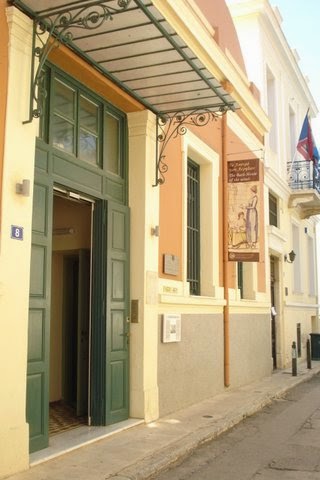

Bath-house of the Winds


Museum of Greek Folk Instruments
Senin, 09 April 2012
A JIMI HENDRIX EXPERIENCE

Back in 1972 when the Georgia Viaduct was built in Vancouver�s East End, it cut right through what had been one of the city�s vibrant neighbourhoods known as Hogan�s Alley. This area was home to Vancouver�s black community and it was filled with after-hours clubs, gambling and bootlegging joints. It was most likely named for Harry Hogan, a black singer who lived at 406 Union Street back in 1921. At that time it not much more than a lane, just eight feet wide and a few blocks long, mainly a collection of horse stables, small cottages and shacks.

Hogan's Alley
One of the landmarks there that I still remember was Vie�s Chicken and Steak House. Vie and her husband ran the restaurant for three decades. It was Hogan�s Alley�s most prominent black-owned business. I might have even gone there during the 50�s or 60�s because it was a popular funky old eatery on what is now Union Street, just off Main. The woman who worked as a cook there was Nora Hendrix, the grandmother of a young man who was to become a rock-and-roll legend, Jimi Hendrix. Nora was born in Tennessee and danced in a vaudeville troupe. She eventually settled in Vancouver in 1911 and married Ross Hendrix. From 1938 to 1952 the Hendrix family lived in Vancouver and raised three children. The youngest son, Al, moved to Seattle and married a girl named Lucille. Their son Jimi was born in 1942.

View of Vie's Chicken & Steak House
Jimi often spent time in Vancouver with his grandparents and spent time practising after hours at Vie�s. His grandmother, Nora, was co-founder of the African Methodist Episcopal Church, a gathering place for gospel singing in this part of Vancouver. Vie�s Chicken and Steak House where she worked was a favourite hang-out for visiting black performers such as Louis Armstrong and Nat King Cole. Perhaps Jimi might have remained in Vancouver after he�d served his time in the US army. He tried living here for awhile and played nightclubs in Hogan�s Alley. But he was discouraged by his father who told him �Vancouver people don�t like the Blues.� So he returned to the States and the rest is musical history. Most of us probably didn�t even realize that Jimi Hendrix had spent so much time early in his music career in Vancouver.

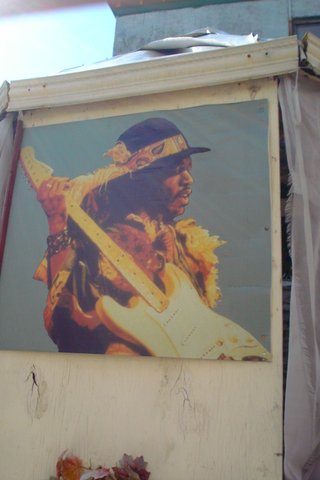
That is, until 2009 when Vincent Fodera, who now owned the property at 207 Union Street, converted a small building that was once associated with Vie�s Chicken and Steak House, into a memorial shrine to the musician. Where the steak house was is now a parking lot, and the tiny building that houses the Jimi Hendrix Memorial Museum was likely just an attached shed. It�s located at the back of the Creekside Student Residence at 796 Main Street. Fodera got the idea of the museum after visiting an exhibit at Seattle�s Experience Music Project in 2003. He has collected Hendrix memorabilia including an outdoor �shrine� where there are memorials to each person involved with Jimi.

Main at Union corner

Jimi Hendrix Memorial Museum


The museum was closed the day I went by. (It opens again in June), but I had an interesting chat with the gardener who was working in the yard. During opening hours there are a number of volunteers acting as docents in the museum including local musicians and Hendrix buffs.


The Memorial Garden
Here are three you-tube videos about the Jimi Hendrix memorial including an interview in Vancouver with Hendrix.

Langganan:
Postingan
(
Atom
)