Tampilkan postingan dengan label boat. Tampilkan semua postingan
Jumat, 18 April 2014
SAILING DOWN THE NILE


The Sonesta Star Goddess?
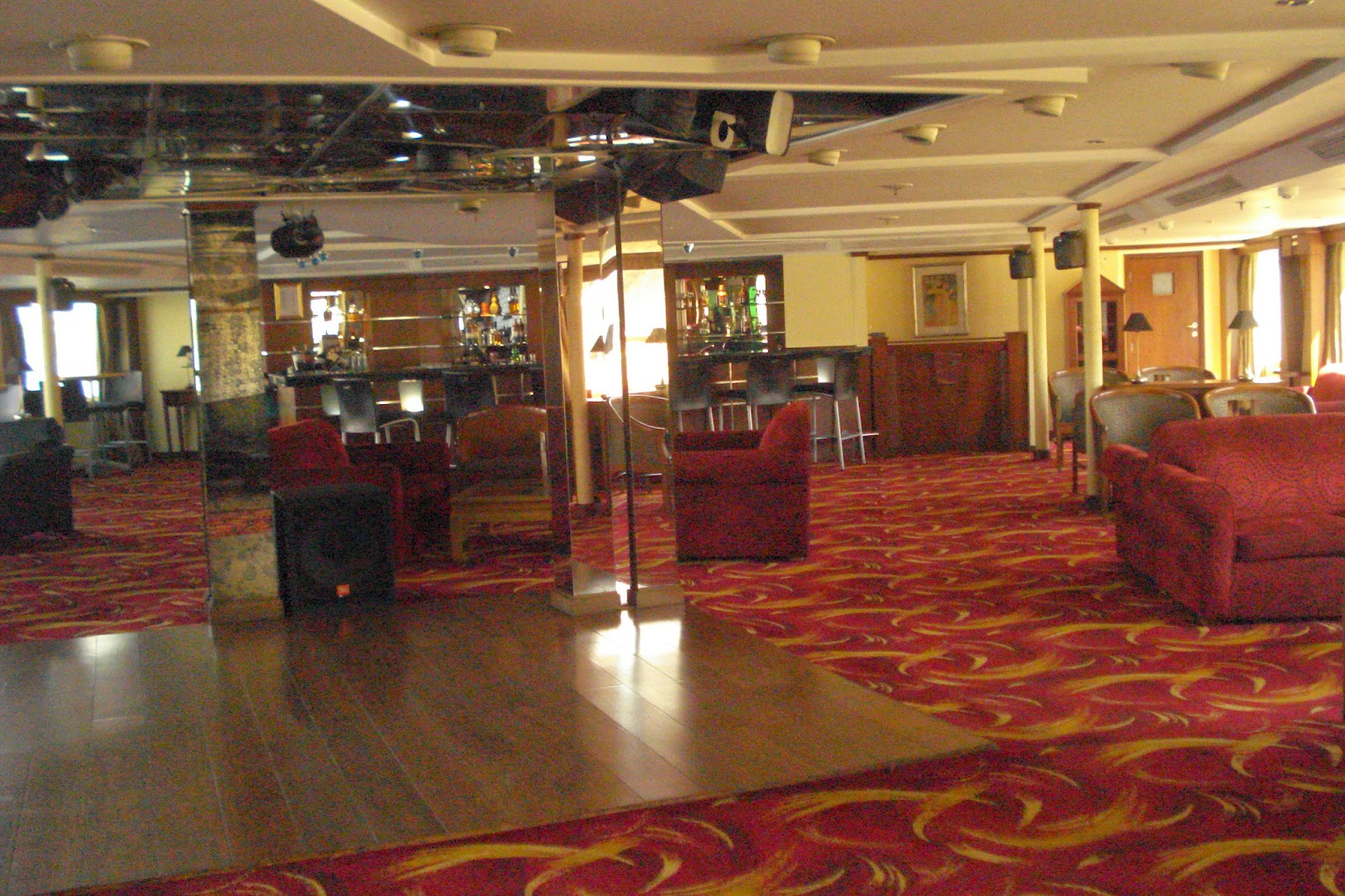
We boarded our river boat, The Sonesta Star Goddess, at Aswan. We were greeted at the gangway by the crew dressed in navy middies, and escorted into the elegant lounge where we were offered warm scented cloths to refresh our faces and hands, and a drink of citrus juice. After having traveled by plane and van for many hours, this was indeed a welcoming! Then we were shown to our suites.
The Crew?
The lounge
?


The cruise ship has 33 suites. Mine was a two-room suite with all the amenities and a small balcony overlooking the river.

After we were settled we were invited for cocktails on the deck and given a tour of the ship. There�s everything a larger cruise ship might have including a spa, exercise room, dining room, bar where there is evening entertainment, various small shops. On the top deck there�s a swimming pool, hot tub, bar and lounge area where you can sit and watch the river slide by.


Sonesta�s fleet of five Nile River cruise ships offer 3-, 4-, and 7-night trips between Aswan and Luxor. http://www.sonesta.com/nilecruises/
I�d had no idea that the Nile River was quite as wide or as beautiful as it actually is. It�s the world�s longest river, flowing approximate 4665 miles out of the heart of Africa, northward to the Mediterranean Sea. There are two sources: The White Niles from equatorial Africa and the White Nile from the Abyssinian highlands. The cataracts, a progression of white rapids form the southern border of Egypt at Sudan. The First Cataract is at Aswan.


We traveled north from Aswan to Luxor on our three-day voyage, stopping each day to visit archaeological sites. Usually we set sail in the late afternoon, sailing during the evening and early morning. It was remarkable how quiet it was, as if the ship was sliding with the current, the pastoral shores slipping by like a silent movie.

Nile Sunset?
Past Aswan, at Edfu, the great Nile Valley begins. Limestone cliffs run parallel along the shore for more than 400 miles, sometimes stretched toward the desert. These cliffs reach heights of 800 feet in some places with mesas and plateaus. The cliffs on the west are like sentinels standing before the Libyan Desert, and on the east they withdraw into the Arabian or Red Sea Deserts. At the delta in Lower Egypt, it fans out with seven major tributaries into the Mediterranean Sea.

For some reason a children�s song kept running through my head as I sat on the deck watching the river flow by:
Oh she
sailed away on a
pleasant summer's day
on the back of a crocodile.
You see, said she, "He's as
tame as he can be, I'll
float him down the Nile."
But the
croc' winked his eye as she
waved to all good-bye,
wearing a sunny smile.
At the
end of the ride the
lady was inside, and the
smile on the croc-o-dile!
sailed away on a
pleasant summer's day
on the back of a crocodile.
You see, said she, "He's as
tame as he can be, I'll
float him down the Nile."
But the
croc' winked his eye as she
waved to all good-bye,
wearing a sunny smile.
At the
end of the ride the
lady was inside, and the
smile on the croc-o-dile!
But it seems there are no crocodiles lurking that part of the Nile now. Since the building of the Aswan Dam in 1960 they all reside on the south side of Lake Nasser, in the White Nile. However, I�d learn later that there is a crocodile museum at Kom Obo.
I was also reminded of Agatha Christie's book Death on the Nile and a friend pointed one out that would have been just the kind of Nile boat (a felucca) that Christie wrote about.


My travel friends and I enjoyed lounging on the upper deck in the warm March sunshine, watching the shoreline slip by. The river�s annual floods deposit fertile soil along its banks so the Nile sustains a variety of fish and fowl. In the reedy marshes egrets, ducks and geese nest. The Nile was known to nurture the sacred lotus, reeds and papyrus plants that were later used for writing on. The ancient Egyptians called the river the �Father of Life� or �Mother of all men�.

Markos, Linda and Yves enjoy a relaxing afternoon?
There is always a parade of farmers leading donkeys laden with produce or cut suger-cane and reed, boys on ponies walking along the river bank under the palms. People toil in fields, and there are herds of goats and cattle grazing near the shore. The name of the river is Greek in origin, a version of the Semetic word �Nakhal�. The ancient Egyptians called it Hap-Ur or Great Hap. The river was the manifest of the god Hapi, a divine spirit that blessed the land with rich silt deposits. The Nile is Egypt�s life-blood.


These days, with tourism at a low ebb, there are few boats operating on the river. Out of more than 229 ships, there are currently only 24 operating on the river. They provide an opportunity for guided excursion to explore the historic landmarks along the river: temples, tombs and ruins, with Egyptologist escorts. And there are plenty of leisure activities on board.
One day the Sonesta operations manager, Mr. Ahmed Tawfick, invited us to tour the kitchens and wheel room. We had been enjoying such amazing gourmet meals it was fun to go into the kitchen to meet the head chef and other staff who daily prepared our delicious meals.

In the wheel room we watched the pilot skillfully navigate the ship up the river. Mr Tawfick explained that there are only three families who are, by tradition, pilots of the Nile cruises and this man has been at the helm for 40 years.

Every night there was entertainment in the bar lounge. The first night was our Captain�s cocktail dinner. The next night was a �Gallabria Party� where passengers dressed in Egyptian costumes and danced to Egyptian music. The third night was a belly dance show with the most amazing dervish who whirled dizzily in colourful skirts.

whirling dervish
On the morning of the fourth day we met in the lobby and prepared to disembark for our cross-country tour van trip through the desert to the Red Sea. I felt sad about leaving the ship after such a welcoming and relaxing cruise. But there were lots more adventures waiting at the Red Sea!
Sonesta�s fleet of five Nile River cruise ships offer 3-, 4-,and 7-night trips between Aswan and Luxor. http://www.sonesta.com/nilecruises/

NEXT: DAY 1 OF THE CRUISE WE STOP AT EDFU AND KOM OMBO
Jumat, 11 April 2014
THE TEMPLE ON AN ISLAND
THE TEMPLE OF PHILAE
After our tour around the Aswan Dam we boarded our Nile cruise ship which would be our home for the next three days. These river cruise ships are small but just as luxurious as big liners. I had a posh two-room suite with a small balcony where I could sit and watch the river. The ship�s name was the Sonesta Star Goddess and I�ll write more about the actual cruise later.
After lunch and a rest, we set off to visit the beautiful Temple of Philae on Philae Island. We would reach the island aboard a small craft piloted by a handsome young Nubian helmsman. Our guide, Hannan, explained that these boatmen, usually dressed in traditional costume, including most of the hawkers who sell souvenirs, are Nubians. They are an ethnic group originally from northern Sudan and southern Egypt and are one of the oldest cultures in Africa. Because most of their agricultural communities were flooded with the building of the dams, now these largely marginalized people live in small settlements along the river.

River boats
?

?
Nubian settlement
We boarded the boat along with our two �bodyguards� and set sail for a rocky island in the middle of the river once known by the Greeks as �Elephantine Island�, probably because it was an important center of trade, especially ivory.

Linda and me having fun on the boat.
The island of Philae was once the centre of commerce between Egypt and Nubia. The granite quarries nearby attracted a population of miners and stonemasons. When the first Aswan Low Dam was completed by the British in 1902, many ancient landmarks including the temple complex of Philae were in danger of being submerged. It was decided to relocate the temples piece by piece to nearby islands but instead the foundations were strengthened instead though the colors of the temples� reliefs were washed away. In 1960 UNESCO started a project to try and save the temples from the destructive effects of the Nile waters. By then the island was submerged up to a third of the buildings all year round. Various methods were used to try and pump the water away but eventually every building was dismantled and transported to a nearby island situated on higher ground.

Philae


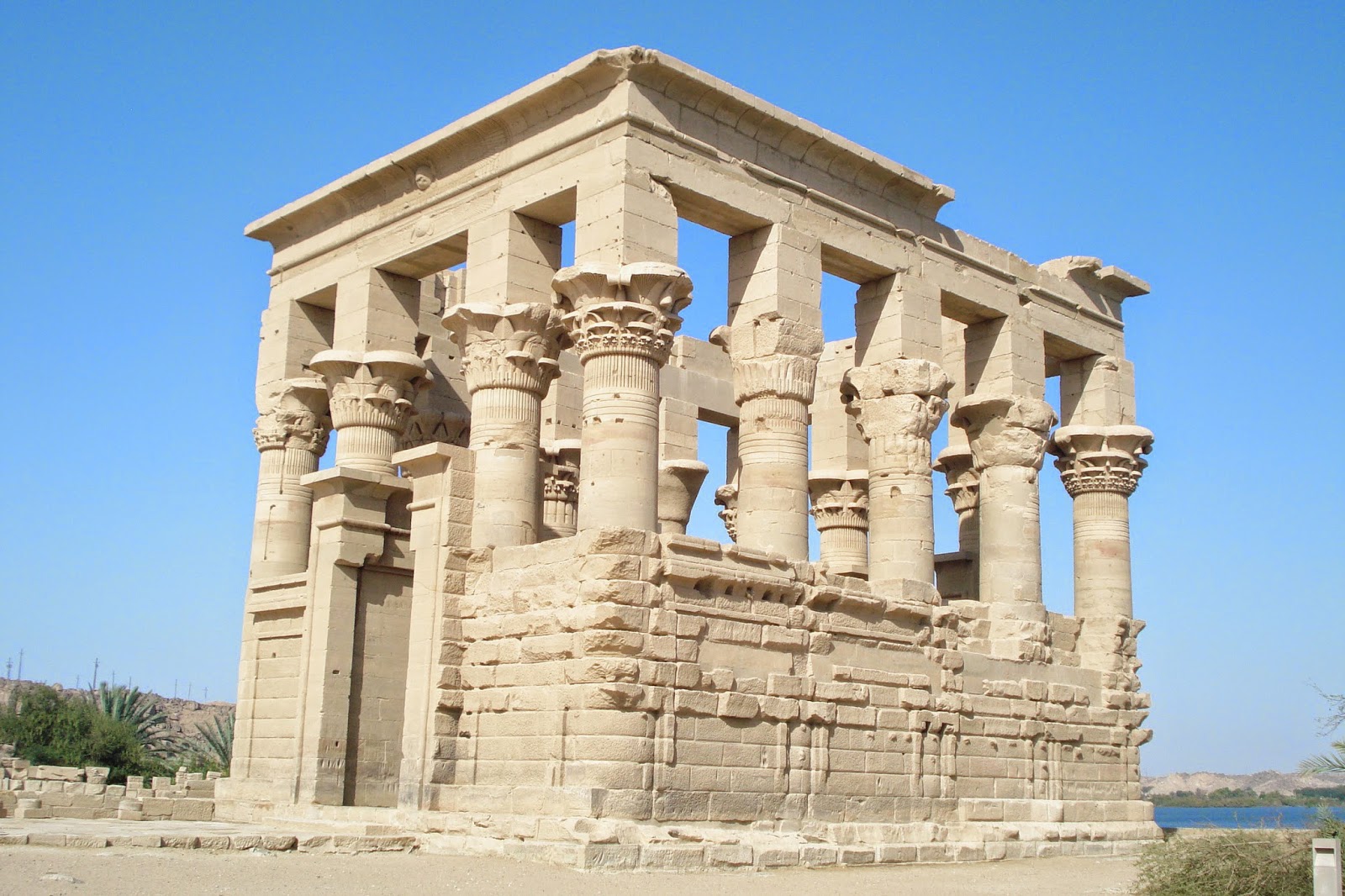
Trajan's Kiosk
The temple was built during the Ptolemaic dynasty, its principal deity being Isis but there are other temples and shrines dedicated to other deities such as Hathor. The most ancient temple was one built for Isis (380-362 BC). It was approached from the river through a double colonnade. Isis was the goddess to whom the first buildings were dedicated

Temple Heiroglyphs


Enjoying myself in this beautiful place?
Because it was supposed to be the burial place of Isis�s husband, Osiris, Philae was held in great reverence both by the Egyptians to the north and the Nubians in the south. Only priests could dwell there. On the walls are inscriptions telling the story of Osiris and how he was murdered. There are also inscriptions from the Macedonian era and sculptures representing the birth of Ptolemy Philometor (383-145 BC) under a figure of the god Horus. There are monuments of various eras, from the Pharaohs to the Caesars. The temple was closed in the 6thcentury AD by the Byzantine emperor Justinian. After that Philae became a seat of the Christian religion. Ruins of a Christian church were discovered on the site. Many of the sculptures and hieroglyphics on the walls of the temple were destroyed or mutilated by these early Christian inhabitants

Christian cross carved into ancient heirglyphs
I was intrigued by the beautiful columns of the temples. Their capitals represent variations of the palm branch and the lotus flower. The walls were painted with bright colours and because of the dry climate they have lost very little of their original brilliance.

Beautiful columns
Our Egyptologist guide, Hanan, made the stories of the past come to life as she explained the stories depicted on the hieroglyphics that told of how Isis took revenge on her husband, Osiris�s, murderer, and explained the significance of their son Horus, the falcon-headed god. Most of Horus�s statues were left unmarred and in many of the wall scenes, every figure except that of Horus and his winged solar-disk were scratched out by the Byzantine Christians, perhaps because they saw some parallel between Horus, the god�s son, and the stories of Jesus.
As we pulled away from the island our two escorts decided to tempt each other by standing on the prow of the little boat. Until then they had stayed pretty well out of sight, dressed in their suits and ties, looking quite business-like. As they were fooling around, threatening to capsize the boat or knock each other into the river, the wind blew their jackets up and to my surprise I spotted two very lethal looking weapons tucked into the backs of their pants. They really were bodyguards! But at that moment we wondered if we'd have to rescue them!

After this fascinating tour of Philae it was time to return to the Sonesta Star Goddess for dinner in the first-class dining room and a welcome long night�s sleep in my lovely luxury suite.
NEXT: Cruising down the Nile to Edfu and Kom Ombo



Jumat, 13 September 2013
FUN ON THE FRASER RIVER


?
My friend Cheryl and I went on a Friday Night Fun Paddlewheeler Cruise on the Fraser River. This was a belated birthday celebration for her and a contract signing celebration for me. I'd always wanted to do one of the paddlewheeler cruises and believe me I will recommend this for anyone wanting a fun, relaxing and scenic little trip. It only cost $34.95 (plus GST) and what we paid for food and drinks, and it was a trip well-worth making again (maybe next time with a group.)There are various trips offered. The FORT LANGLEY trip covers part of the Gold Rush Trail and includes buffet lunch. The PITT LAKE WILDERNESS CRUISE visited legendary places on the lake including Native pictographs etc. It includes full lunch,desert, and tea or coffee. The SUNSET DINNER (7 - 10 pm on Saturdays) is a good way to celebrat special events with family and friends and also includes a buffet dinner and soft music. The STEVESTON FISHING BILLAGE tour on Wednesdays travels down the river to Ladner Reach, past Riefel Island and returns via the Annacis Channel with stops to visit the Gulf of Georgia Cannery. The DISCOVER THE FRASER trip on Wednesday and Saturday includes lunch and takes a course like the Friday Night Fun Trip under the bridges and past the Surrey Docks. The fares vary and there are special fares for children.


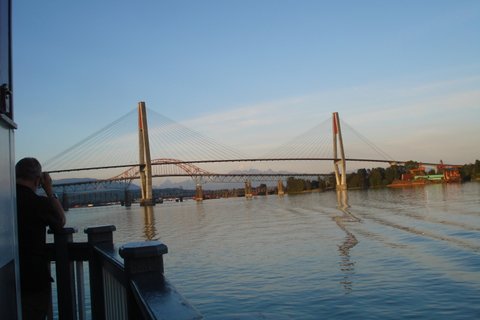
We boarded a 7.30 from the dock in New Westminster, settled ourselves on the deck to enjoy the mild summer evening, and set sail up to river under the bridges, then when it grew dusk, back down again. We ate dinner on the deck, a choice of excellent dishes from the menu. There's also a nice dining room on board if you wish to be indoors.

As the paddlewheeler cruised along the river, and under the bridges, we enjoyed the serene views from the deck. It couldn't have been more relaxing!



?
After dinner we went downstairs where a DJ was playing the oldies and goodies disco music. Funny, it was mainly the women dancing but we had a ball! It was so much fun that we agreed it would be a great place to come with a group of friends to celebrate special occasions. The dance party lasted three hours and then we were back in port again, fully satisfied and delighted with our choice of this special celebration voyage.

If you want to go: The Paddlewheeler Riverboat Tours, On the Mighty Fraser River,
788 Quayside Drive, New Westminster B.C.
604-525-4465. On the New Westminster Quay.
Senin, 08 April 2013
artifacts
,
boat
,
boat building
,
culture
,
family fun
,
fishermen
,
heritage
,
historical sites
,
Japanese
,
museums
,
park
,
tradition
Tidak ada komentar
A VISIT TO NIKKEI PLACE AND MUSEUM
It's taken me a long time to make a point to visit the National Nikkei Museum and Heritage Centre. I used to post regular program notices for them when I wrote for Planet Eye Traveler (The Vancouver Guide) but as many times as I'd intended to take in some of their exhibits or just pass by to say hello, I didn't get around to it.

Last week, however, I needed to stop in to pick up a gift packet for the BC Travel Writer's gala in May. Once I got there, I was more than sorry I'd neglected to go sooner.
The multi-use facility houses the National Nikkei Heritage Centre and the Japanese Canadian National Museum. It's located at the corner of Sperling and Kingsway and easy to reach by public transit if you don't have a car.
The Centre promotes understanding and appreciation of the Japanese Canadian culture and heritage and the contribution of Japanese Canadians to our Canadian society. They offer many programs and special events including art exhibits, a speaker's series, bazaars and many other problems both for youth and elders included. There's art classes, folk dance workshops, exercise groups such as yoga, flower arranging and even a course in the traditional incense ceremony.

When I arrived at the Centre I was first impressed by the lovely gardens that surround the building. The cherry blossoms were all in bloom which seemed appropriate. The building itself is impressive and much larger than I'd expected.


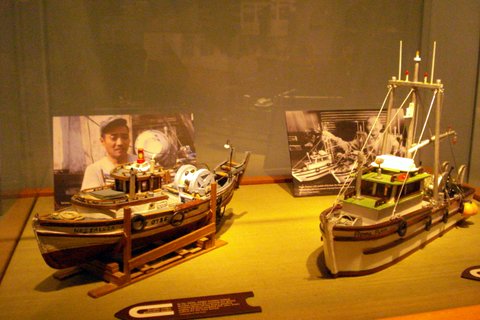
I only stayed a short while and mainly visited the museum on the ground floor where there is an exhibit of Ryoshi: Nikkei fishing on the BC Coast. (It runs until May 19,2013). The admission is by donation. It displays the fisherman's life from the bustling docks of Steveston to the remote inlets on the northern Coast. For many years Japanese Canadians have made a unique contribution to fishing in BC both before and after the war.


Upstairs in the museum there is an exhibit of Taiken: Japanese Canadians Since 1877. It's an ongoing exhibit so I'll have to go back and take a look. It deals with the first arrivals of Nissei in 1877 and the hardships of the early pioneers and struggles during the war years when the Japanese of the Coast were interned and their properties confiscated.


Don't pass up this interesting Museum and Cultural Centre. It's open every day but Monday.
Check their website for more information on programs and exhibits.
www.nikkeiplace.org

Langganan:
Postingan
(
Atom
)